
+44 20 7831 8415
Turn Your Ideas into Beautiful Custom Jewelry
info@elegancejewellers.co.uk

Elegance

Elegance
  • DIAMONDS
    LOOSE DIAMONDS
    • Round Round
    • Princess Princess
    • Cushion Cushion
    • Emerald Emerald
    • Oval Oval
    • Radiant Radiant
    • Asscher Asscher
    • Marquise Marquise
    • Heart Heart
    • Pear Pear
    CREATE YOUR OWN RING
    • Start With An Earth Mined Diamond Start With An Earth Mined Diamond
    • Start With A Lab Grown Diamond Start With A Lab Grown Diamond
    • Start With A Setting Start With A Setting
    LEARN ABOUT
    • Diamond Shapes
    • 4C's Of A Diamond
  • GEMSTONES
    CREATE YOUR OWN RING
    • Start With A Gemstone Start With A Gemstone
    • Start With A Setting Start With A Setting
    SHOP BY TYPE
    • Round Round
    • Princess Princess
    • Cushion Cushion
    • Emerald Emerald
    • Oval Oval
    • Radiant Radiant
    • Asscher Asscher
    • Marquise Marquise
    • Heart Heart
    • Pear Pear
    GEMSTONE TYPE
    • Alexandrite Alexandrite
    • Emerald Emerald
    • Garnet Garnet
    • Opal Opal
    • Peridot Peridot
    • Ruby Ruby
    • Sapphire Sapphire
    • Tanzanite Tanzanite
    • Tourmaline Tourmaline
    SHOP BY COLOR
    • Red Red
    • Green Green
    • Blue Blue
    • Yellow Yellow
    • Pink Pink
    • Brown Brown
    • Purple Purple
    • Orange Orange
  • ENGAGEMENT RINGS
    CREATE YOUR OWN RING
    • Start With A Setting Start With A Setting
    • Start With An Earth Mined Diamond Start With An Earth Mined Diamond
    • Start With A Lab-Grown Diamond Start With A Lab-Grown Diamond
    LEARN ABOUT
    • Ring Types
    • Ring Size Guide
    SHOP BY STYLE
    • Halo Halo
    • Three Stone Three Stone
    • Vintage Vintage
    • Bypass Bypass
    • Solitaire Solitaire
    • Single Row Single Row
    • Multirow Multirow
    • Pave Pave
    SHOP BY METAL
    • Rose Gold Rose Gold
    • White Gold White Gold
    • Yellow Gold Yellow Gold
    • Platinum Platinum
    SHOP BY SHAPE
    • Round Round
    • Princess Princess
    • Cushion Cushion
    • Oval Oval
    • Emerald Emerald
    • Marquise Marquise
    • Pear Pear
    • Radiant Radiant
    • Heart Heart
    • Asscher Asscher
    Engagement Rings
  • WEDDING RINGS
    SHOP BY STYLE
    • Eternity Eternity
    • Stackable Stackable
    • Pave Pave
    • Bezel Set Bezel Set
    SHOP BY METAL
    • Rose Gold Rose Gold
    • White Gold White Gold
    • Yellow Gold Yellow Gold
    • Platinum Platinum
  • FINE JEWELRY
    SHOP BY TYPE
    • Rings Rings
    • Pendants Pendants
    • Necklaces Necklaces
    • Bracelets Bracelets
    • Earrings Earrings
    SHOP BY METAL
    • Rose Gold Rose Gold
    • Yellow Gold Yellow Gold
    • White Gold White Gold
    • Platinum Platinum
    LEARN ABOUT
    • Your Jewelry
    READY TO SHIP
    • Engagement Rings
    • Wedding Bands
    • Other Jewellery
Book An Appointment
Cart 0 item £0.00
Elegance
Cart 0 item £0.00
Login or Sign Up
+44 20 7831 8415 Email us
DIAMONDS

LOOSE DIAMONDS

  • Round Round
  • Princess Princess
  • Cushion Cushion
  • Emerald Emerald
  • Oval Oval
  • Radiant Radiant
  • Asscher Asscher
  • Marquise Marquise
  • Heart Heart
  • Pear Pear

CREATE YOUR OWN RING

  • Start With An Earth Mined Diamond Start With An Earth Mined Diamond
  • Start With A Lab Grown Diamond Start With A Lab Grown Diamond
  • Start With A Setting Start With A Setting

LEARN ABOUT

  • Diamond Shapes
  • 4C's Of A Diamond
GEMSTONES

CREATE YOUR OWN RING

  • Start With A Gemstone Start With A Gemstone
  • Start With A Setting Start With A Setting

SHOP BY TYPE

  • Round Round
  • Princess Princess
  • Cushion Cushion
  • Emerald Emerald
  • Oval Oval
  • Radiant Radiant
  • Asscher Asscher
  • Marquise Marquise
  • Heart Heart
  • Pear Pear

GEMSTONE TYPE

  • Alexandrite Alexandrite
  • Emerald Emerald
  • Garnet Garnet
  • Opal Opal
  • Peridot Peridot
  • Ruby Ruby
  • Sapphire Sapphire
  • Tanzanite Tanzanite
  • Tourmaline Tourmaline

SHOP BY COLOR

  • Red Red
  • Green Green
  • Blue Blue
  • Yellow Yellow
  • Pink Pink
  • Brown Brown
  • Purple Purple
  • Orange Orange
ENGAGEMENT RINGS

CREATE YOUR OWN RING

  • Start With A Setting Start With A Setting
  • Start With An Earth Mined Diamond Start With An Earth Mined Diamond
  • Start With A Lab-Grown Diamond Start With A Lab-Grown Diamond

LEARN ABOUT

  • Ring Types
  • Ring Size Guide

SHOP BY STYLE

  • Halo Halo
  • Three Stone Three Stone
  • Vintage Vintage
  • Bypass Bypass
  • Solitaire Solitaire
  • Single Row Single Row
  • Multirow Multirow
  • Pave Pave

SHOP BY METAL

  • Rose Gold Rose Gold
  • White Gold White Gold
  • Yellow Gold Yellow Gold
  • Platinum Platinum

SHOP BY SHAPE

  • Round Round
  • Princess Princess
  • Cushion Cushion
  • Oval Oval
  • Emerald Emerald
  • Marquise Marquise
  • Pear Pear
  • Radiant Radiant
  • Heart Heart
  • Asscher Asscher
WEDDING RINGS

SHOP BY STYLE

  • Eternity Eternity
  • Stackable Stackable
  • Pave Pave
  • Bezel Set Bezel Set

SHOP BY METAL

  • Rose Gold Rose Gold
  • White Gold White Gold
  • Yellow Gold Yellow Gold
  • Platinum Platinum
FINE JEWELRY

SHOP BY TYPE

  • Rings Rings
  • Pendants Pendants
  • Necklaces Necklaces
  • Bracelets Bracelets
  • Earrings Earrings

SHOP BY METAL

  • Rose Gold Rose Gold
  • Yellow Gold Yellow Gold
  • White Gold White Gold
  • Platinum Platinum

LEARN ABOUT

  • Your Jewelry

READY TO SHIP

  • Engagement Rings
  • Wedding Bands
  • Other Jewellery
SHOPPING BASKET WISH LIST STORES - COME VISIT US! VIRTUAL APPOINTMENT EDUCATION BLOG CREATE AN ACCOUNT
  1. Home
  2. Diamond 4C’s

Diamond 4C’s

Courtesy GIA

WHY THE 4Cs?

The 26 D-Flawless diamonds of various shapes and sizes cut from the Lesotho Promise crystal. Courtesy: Graff

Once upon a time, there was no agreed-upon standard by which diamonds could be evaluated. Traders and jewelers used terms such as river or water to describe diamonds that were the most colorless, and Cape to describe pale yellow diamonds from South Africa’s Cape of Good Hope region. A diamond’s cut was described as “made well” or “made poorly.”

Then in the 1940s, Robert M. Shipley, the founder of GIA, coined the term 4Cs to help his students remember the four factors that characterize a faceted diamond: color, clarity, cut and carat weight. The concept was simple, but revolutionary.

His successor, President Richard T. Liddicoat, expanded his work by developing the now universally-utilized GIA D-to-Z Color Scale and GIA Clarity Scale for diamonds. He also established the scientific methods and procedures for objectively grading a diamond’s quality.

The creation of the Diamond 4Cs and the GIA International Diamond Grading System™ meant two very important things: diamond quality could be communicated in a universal language, and diamond customers could now know exactly what they are purchasing.

Today, the 4Cs of Diamond Quality is the universal method for assessing the quality of any diamond, anywhere in the world. As the creator of the Diamond 4Cs and the International Diamond Grading System™, GIA is trusted by museums, auctions houses, and consumers all over the world to grade nature’s finest treasures.

DIAMOND COLOR

Diamond Color Actually Means Lack of Color
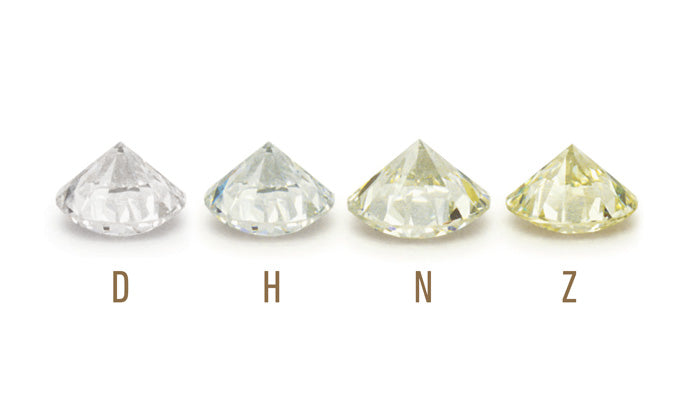
To understand diamond clarity, we must first understand how diamonds are created. Natural diamonds are the result of carbon exposed to tremendous heat and pressure deep in the earth. This process can result in a variety of internal characteristics called ‘inclusions’ and external characteristics called ‘blemishes.’

Evaluating diamond clarity involves determining the number, size, relief, nature, and position of these characteristics, as well as how these affect the overall appearance of the stone. If you are trying to determine what is the best clarity for a diamond, remember that no diamond is perfectly pure. But the closer it comes to purity, the better its clarity.

The GIA Diamond Clarity Scale has 6 categories, some of which are divided, for a total of 11 specific grades.

  • Flawless (FL) No inclusions and no blemishes visible under 10x magnification
  • Internally Flawless (IF) No inclusions visible under 10x magnification
  • Very, Very Slightly Included (VVS1 and VVS2) Inclusions so slight they are difficult for a skilled grader to see under 10x magnification
  • Very Slightly Included (VS1 and VS2) Inclusions are observed with effort under 10x magnification, but can be characterized as minor
  • Slightly Included (SI1 and SI2) Inclusions are noticeable under 10x magnification
  • Included (I1, I2, and I3) Inclusions are obvious under 10x magnification which may affect transparency and brilliance

DIAMOND CUT

Understanding Diamond Cut
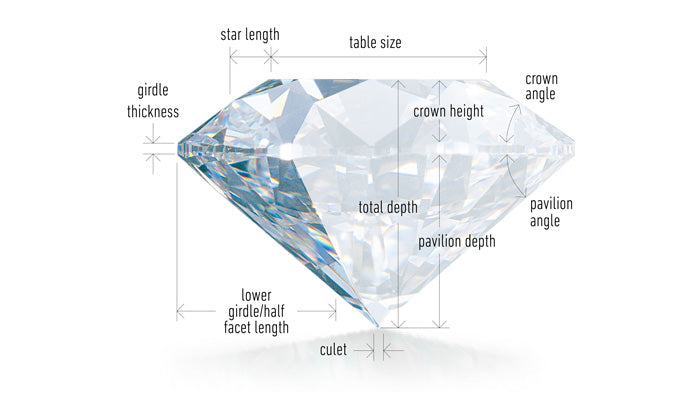
Diamonds are renowned for their ability to transmit light and sparkle so intensely. We often think of a diamond’s cut as shape (round, heart, oval, marquise, pear), but what diamond cut actually does mean is how well a diamond’s facets interact with light. Precise artistry and workmanship are required to fashion a stone so its proportions, symmetry and polish deliver the magnificent return of light only possible in a diamond.

Achieving the best cut for a diamond reflects in the stone’s final beauty and value. And of all the diamond 4Cs, it is the most complex and technically difficult to analyze. To determine the cut grade of the standard round brilliant diamond – the shape that dominates the majority of diamond jewelry – GIA calculates the proportions of those facets that influence the diamond’s face-up appearance. These proportions allow GIA to evaluate what the best cut for a diamond is, by studying how successfully a diamond interacts with light to create desirable visual effects, such as:

  • Brightness: Internal and external white light reflected from a diamond
  • Fire: The scattering of white light into all the colors of the rainbow
  • Scintillation: The amount of sparkle a diamond produces, and the pattern of light and dark areas caused by reflections within the diamond

DIAMOND CARAT WEIGHT

Diamond Carat Weight Measures a Diamond’s Apparent Size
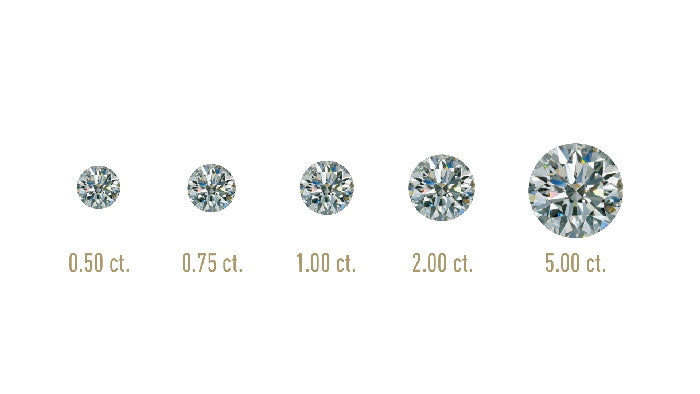
To put it simply, diamond carat weight measures how much a diamond weighs.

A metric “carat” is defined as 200 milligrams. Each carat is subdivided into 100 ‘points.’ This allows very precise measurements to the hundredth decimal place. A jeweler may describe the weight of a diamond below one carat by its ‘points’ alone. For instance, the jeweler may refer to a diamond that weighs 0.25 carats as a ‘twenty-five pointer.’ Diamond weights greater than one carat are expressed in carats and decimals. A 1.08 carat stone would be described as ‘one point oh eight carats.’

All else being equal, diamond price increases with diamond carat weight because larger diamonds are rarer and more desirable. However, two diamonds of equal carat weight can have very different values (and prices) depending on three other factors of the diamond 4Cs: Color, Clarity, and Cut.

While now you know what carat means, it’s also important to remember that a diamond’s value is determined using all of the 4Cs, and not just carat weight.

Sign up for practical advice on the irrational matters of the heart.

Be the first to know about new collections and exclusive offers.

Information

  • About Us
  • Contact Us
  • Education
  • Our Services
  • Privacy Policy
  • Terms & Conditions
  • Book Appointment

Collection

  • Rings
  • Necklaces
  • Earrings
  • Pendants
  • Bracelets

Get In Touch

9 Greville St, Hatton Garden, London EC1N 8SB, United Kingdom
+44 20 7831 8415
info@elegancejewellers.co.uk

© 2026 All Rights Reserved.
Designed & Developed by Belgium Webnet Inc.

  • Facebook
  • Instagram
  • Twitter
  • Pinterest

Your cart is currently empty.

Enable cookies to use the shopping cart